Single Crochet Tutorial: Easy Step-by-Step Guide for Beginners
If you are holding a crochet hook for the first time, the single crochet tutorial is one of the best places to start. Single crochet is a simple, useful stitch that creates a firm fabric and appears in everything from washcloths and coasters to blankets, bags, amigurumi, and clothing.
The good news? You only need to learn a few basic movements to make your first single crochet stitch. Once you understand where to insert the hook, how to yarn over, and how to pull the loops through, the stitch becomes much easier.
In this beginner-friendly guide, I’ll walk you through single crochet step by step, explain common mistakes, show how to count stitches, and share a few practical tips that can make your first crochet projects much less frustrating.
What Is Single Crochet?
Single crochet is one of the basic crochet stitches used in many beginner and intermediate patterns. It creates a relatively short, dense stitch with a neat texture.
In US crochet terminology, single crochet is abbreviated as SC. You will often see instructions such as:
“Make 10 SC across.”
That means you need to work one single crochet stitch into each of the next 10 stitches.
Single crochet is particularly useful when you want a fabric that holds its shape. It is also commonly used for borders, amigurumi, small accessories, and projects that need a tighter structure.
Single Crochet at a Glance
| Feature | Single Crochet |
|---|---|
| US abbreviation | SC |
| Difficulty | Beginner |
| Height | Short |
| Fabric | Firm and dense |
| Common uses | Amigurumi, bags, coasters, blankets |
| Basic movement | Insert, yarn over, pull through, yarn over, pull through |
One important detail: crochet terminology differs between the US and UK. In UK patterns, the term double crochet (DC) refers to the stitch called single crochet (SC) in US terminology. Always check which terminology a pattern uses before beginning.
Single Crochet Tutorial: What You Need
You do not need a large collection of supplies to practice single crochet. A hook, some yarn, and a comfortable place to work are enough.
Crochet Hook
For beginners, a medium-sized crochet hook is usually easier to handle than a very tiny hook.
A hook around 5.0 mm works well with many medium-weight yarns, although you should always check the yarn label for its recommended hook size.
Yarn
Choose a smooth, medium-weight yarn in a light or medium color.
Very dark yarn can make it difficult to see individual stitches. Extremely fuzzy yarn can also make learning harder because the loops are less visible.
Scissors
A small pair of sharp scissors is useful for cutting yarn when you finish your practice piece.
Tapestry Needle
You may not need one immediately, but a tapestry needle is helpful when you need to weave in yarn ends.
How to Hold the Crochet Hook
There is no single “correct” way to hold a crochet hook as long as you can control it comfortably.
Many crocheters hold the hook using a pencil-style grip, while others use a knife-style grip.
The important thing is to avoid squeezing the hook too tightly.
A relaxed hand makes it easier to move the hook through the yarn. If your fingers, wrist, or hand begin to feel tense, stop for a moment and loosen your grip.
How to Make a Single Crochet Stitch
Now let’s get into the main part of this single crochet tutorial.
Before making single crochet stitches, you will usually begin with a slip knot and a foundation chain.
Step 1: Make a Slip Knot
Create a loop with your yarn and pull a section of the working yarn through the loop.
Place the resulting loop onto your crochet hook.
The loop should sit comfortably around the hook. It should not be so tight that the hook cannot move freely.
Step 2: Make a Foundation Chain
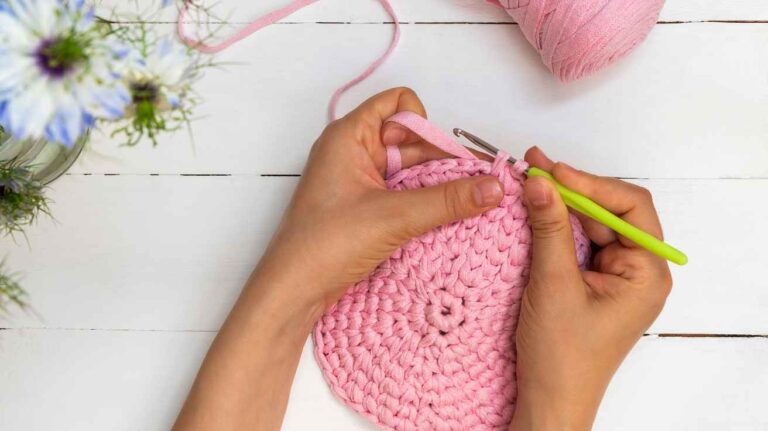
Hold the yarn and hook comfortably.
Wrap the working yarn over the hook from back to front. This movement is called a yarn over, often abbreviated as YO.
Pull the hook through the loop on your hook.
You have now made one chain stitch.
Continue until you have the number of chains required for your practice piece.
For example, you can make a chain of 12–15 stitches when practicing.
Step 3: Insert the Hook Into the Chain
To make your first single crochet, insert your hook into the appropriate chain stitch.
For a typical row worked into a foundation chain, you generally skip the chain closest to the hook and insert into the next chain, unless the pattern specifies otherwise.
Insert the hook underneath the top loops of the chain.
Step 4: Yarn Over
With your hook inside the chain, yarn over.
Use the hook to catch the working yarn.
Step 5: Pull Up a Loop
Pull the yarn through the chain.
You should now have two loops on your hook.
This is an important checkpoint.
If you have only one loop, the yarn was not pulled through correctly. If you have more than two, check where your hook entered and how many times you yarned over.
Step 6: Yarn Over Again
Yarn over once more.
You should still have two loops on your hook before pulling the yarn through.
Step 7: Pull Through Both Loops
Pull the yarn through both loops on your hook.
You now have one loop remaining on the hook.
That is one single crochet stitch.
Repeat these steps across the foundation chain.
The Single Crochet Motion to Remember
Once you understand the sequence, single crochet becomes much easier to remember:
Insert → Yarn over → Pull up a loop → Yarn over → Pull through both loops
That is the entire basic single crochet stitch.
The most useful beginner trick is to memorize the two-loop checkpoint. After you pull up the first loop, stop briefly and check that you have two loops on your hook. Then yarn over and pull through both.
How to Make a Row of Single Crochet
Once you have completed your first row, you need to turn your work if you want to crochet another row.
Step 1: Finish the Row
Continue making one single crochet into each stitch across the row.
Count your stitches before moving on.
Step 2: Chain One
At the end of the row, make one chain stitch.
This is commonly used as the turning chain for single crochet.
Step 3: Turn Your Work
Turn the crocheted fabric around so you can work back across the row.
Step 4: Find the First Stitch
Look carefully at the top edge of your work.
The stitches usually look like small V shapes.
Insert your hook into the appropriate stitch and make another single crochet.
Continue across the row.
How to Count Single Crochet Stitches
Counting stitches is one of the most important beginner crochet skills.
A common mistake is accidentally adding or losing stitches at the beginning or end of a row.
To count your single crochet stitches, look along the top edge of the row. Each completed stitch generally creates a small V-shaped loop.
For example, if your pattern says to make 20 single crochet stitches, you should be able to count 20 V shapes across the row.
A Simple Counting Habit
Count your stitches at the end of every row.
If you started with 20 stitches and suddenly have 18 or 22, stop and find the mistake before continuing.
Fixing a mistake immediately is much easier than discovering several rows later that your project has changed shape.
Common Single Crochet Mistakes
Learning crochet usually involves a little trial and error. Don’t worry if your first swatch looks uneven.
Inserting the Hook in the Wrong Place
Beginners sometimes insert the hook into only one part of the stitch when the pattern calls for both top loops.
Look for the small V on top of the stitch and check your pattern instructions.
Accidentally Skipping a Stitch
The first and last stitches of a row can be easy to miss.
This is one of the main reasons crochet projects become narrower as you work upward.
Place a stitch marker in the first or last stitch if you have trouble seeing where the row begins and ends.
Making the Chain Too Tight
A tight foundation chain can make the first row surprisingly difficult.
If your hook struggles to enter the chain, try relaxing your tension or using a slightly larger hook for the foundation chain.
Pulling the Yarn Too Tightly
Crochet should not require excessive force.
If you constantly have trouble pulling your hook through loops, your tension may be too tight.
Try keeping your yarn hand relaxed and allowing the hook to move naturally.
Losing Track of Your Stitch Count
Even experienced crocheters can lose count.
For beginners, counting every few stitches can help develop a better sense of the structure of the fabric.
How to Keep Your Single Crochet Even
Your first few rows may look uneven. That’s normal.
Your tension will usually improve as your hands become familiar with the movement.
Try these techniques:
- Keep the same yarn tension throughout the row.
- Avoid pulling each stitch extremely tight.
- Use the same hook and yarn while practicing.
- Count your stitches regularly.
- Practice several rows before judging your technique.
- Use stitch markers when necessary.
- Keep your working yarn moving smoothly.
A useful insight is to practice tension before trying to make a perfect project. Many beginners focus entirely on whether each stitch looks correct, but consistent tension often makes a bigger difference to the finished fabric.
What Can You Make With Single Crochet?
Once you can confidently make rows of SC, you can start experimenting with simple projects.
Crochet Coasters
Small crochet coasters are excellent practice projects because they don’t require much yarn or time.
You can practice making straight rows while learning how to maintain an even stitch count.
Washcloths
A simple square washcloth is another useful project.
Cotton yarn is commonly used for this type of project because it is practical and washable.
Crochet Bags
Single crochet creates a sturdy fabric that can work well for simple crochet bags and pouches.
You can later experiment with stripes, color changes, handles, and decorative borders.
Amigurumi
Single crochet is extremely common in amigurumi, where crocheters create stuffed animals, characters, and other three-dimensional shapes.
Amigurumi usually uses continuous rounds rather than traditional back-and-forth rows.
Blankets
Single crochet can also be used to create blankets.
Because the stitch creates a relatively dense fabric, keep in mind that a large single-crochet blanket can become heavier than one made with taller, more open stitches.
Single Crochet vs. Other Basic Crochet Stitches
Understanding how single crochet compares with other stitches can help you choose the right technique for a project.
| Stitch | US Abbreviation | Height | Typical Fabric |
|---|---|---|---|
| Chain | CH | Very short | Foundation/open |
| Single crochet | SC | Short | Dense |
| Half double crochet | HDC | Medium | Moderately dense |
| Double crochet | DC | Tall | More open |
| Treble crochet | TR | Very tall | Open |
Single crochet is generally a good choice when you want structure and a compact fabric.
If you want your project to grow more quickly and have more drape, taller stitches may be more appropriate.
Single Crochet in the Round
Once you understand single crochet in rows, you can learn to work it in rounds.
Working in rounds means that instead of turning after every row, you continue around a circular or spiral structure.
This technique is especially important for:
- Amigurumi
- Crochet baskets
- Hats
- Small bowls
- Round coasters
- Decorative motifs
When working in the round, stitch markers become particularly useful because it can be harder to identify where one round begins and ends.
How to Fix a Single Crochet Mistake
Making mistakes is part of learning.
If you notice a mistake immediately, you can often undo the last stitch by carefully pulling the working yarn backward.
This process is commonly called frogging in crochet.
If the mistake is several stitches or rows back, you may need to undo more of your work.
Don’t see frogging as wasted time. It is actually one of the fastest ways to learn how your stitches are constructed.
How Long Does It Take to Learn Single Crochet?
Most beginners can understand the basic single crochet movement after a short practice session.
However, understanding the stitch and producing consistently even stitches are two different things.
You may learn the basic sequence quickly but need several practice sessions before your tension, stitch count, and edges become consistent.
Instead of trying to master everything in one sitting, make a small practice swatch of several rows.
The goal isn’t speed. The goal is being able to recognize what a correct stitch looks like.
A Simple Beginner Practice Exercise
If you want to practice the technique without committing to a large project, try this:
- Make a foundation chain of about 15 stitches.
- Work single crochet across the chain.
- Chain one and turn.
- Work single crochet across the next row.
- Repeat for 10–15 rows.
- Count your stitches after each row.
- Look at the edges and check whether they remain straight.
After several rows, you’ll start noticing whether your tension is becoming more consistent.
Frequently Asked Questions About Single Crochet
What is the easiest way to learn single crochet?
The easiest approach is to learn the stitch in four basic movements: insert the hook, yarn over and pull up a loop, yarn over again, then pull through both loops. Practice these movements slowly before trying a full project.
What does SC mean in crochet?
SC means single crochet in US crochet terminology. It is a short stitch that creates a relatively dense fabric and is widely used in blankets, bags, amigurumi, accessories, and borders.
How many chains do I need to start single crochet?
The number of chains depends on the project. For practice, 12–15 chains is enough to make a small swatch. A crochet pattern will normally tell you exactly how many foundation chains to make.
Why does my single crochet look so tight?
Your yarn tension may be too tight, or your foundation chain may be too small. Relax your grip, avoid pulling the working yarn excessively, and consider using a slightly larger hook while practicing.
Is single crochet good for beginners?
Yes. Single crochet is one of the fundamental stitches and is a useful starting point for beginners. Once you understand it, many simple crochet patterns become easier to follow.
Conclusion
Learning crochet doesn’t require mastering dozens of stitches at once. Start with one solid foundation, and single crochet is an excellent choice.
Remember the basic sequence: insert, yarn over, pull up a loop, yarn over, and pull through both loops. Practice several rows, count your stitches, and focus on keeping your tension comfortable rather than trying to crochet quickly.
Once your single crochet becomes familiar, you can use it for practical projects such as coasters, washcloths, bags, blankets, and amigurumi.
Ready to practice? Grab your hook and yarn, make a small foundation chain, and work your first 10 rows of single crochet. Your first swatch doesn’t need to be perfect—it just needs to help your hands learn.


8 Comments