Half Double Crochet Tutorial: Easy Step by Step Guide
If you’re learning crochet and want a stitch that is taller than single crochet but simpler than double crochet, the half double crochet is a great place to start. This versatile stitch creates a soft, slightly textured fabric that works beautifully for blankets, scarves, hats, bags, and many other projects.
In this half double crochet tutorial, I’ll walk you through everything you need to know, from choosing your yarn and hook to making your first stitch and keeping your edges straight. I’ll also explain where to insert your hook, how to count stitches, and how to fix common beginner mistakes.
Once you understand the basic movement, you’ll find that half double crochet becomes one of those stitches you can make almost without thinking.
What Is Half Double Crochet?
Half double crochet, commonly abbreviated as HDC, is a basic crochet stitch that falls between single crochet and double crochet in height.
The stitch is made by wrapping the yarn around your hook, inserting the hook into the stitch, pulling up a loop, and then pulling the yarn through all three loops on the hook.
The result is a stitch that is:
- Taller than single crochet
- Shorter than double crochet
- Faster to work than single crochet
- Soft and slightly textured
- Suitable for both flat and round crochet projects
One useful detail for beginners is that HDC uses three loops during the final step. This is different from double crochet, where you work through the loops in stages.
Half Double Crochet Tutorial: What You Need
You only need a few basic supplies to practice this stitch.
Yarn
Medium-weight worsted yarn is a good choice for beginners because it is easy to see and handle. Choose a light or medium color so you can clearly see the individual stitches.
Crochet Hook
Use the hook size recommended on your yarn label. For many medium-weight yarns, a hook around 5 mm is a comfortable starting point.
Scissors
Keep a small pair of sharp scissors nearby for cutting the yarn when you finish.
Tapestry Needle
A yarn needle is useful for weaving in the loose ends after your practice swatch or finished project.
How to Make a Half Double Crochet Step by Step
Now let’s get into the actual half double crochet tutorial.
If you’re completely new to crochet, don’t worry about speed. Focus on learning where the hook goes and how the loops move.
Step 1: Make Your Foundation Chain
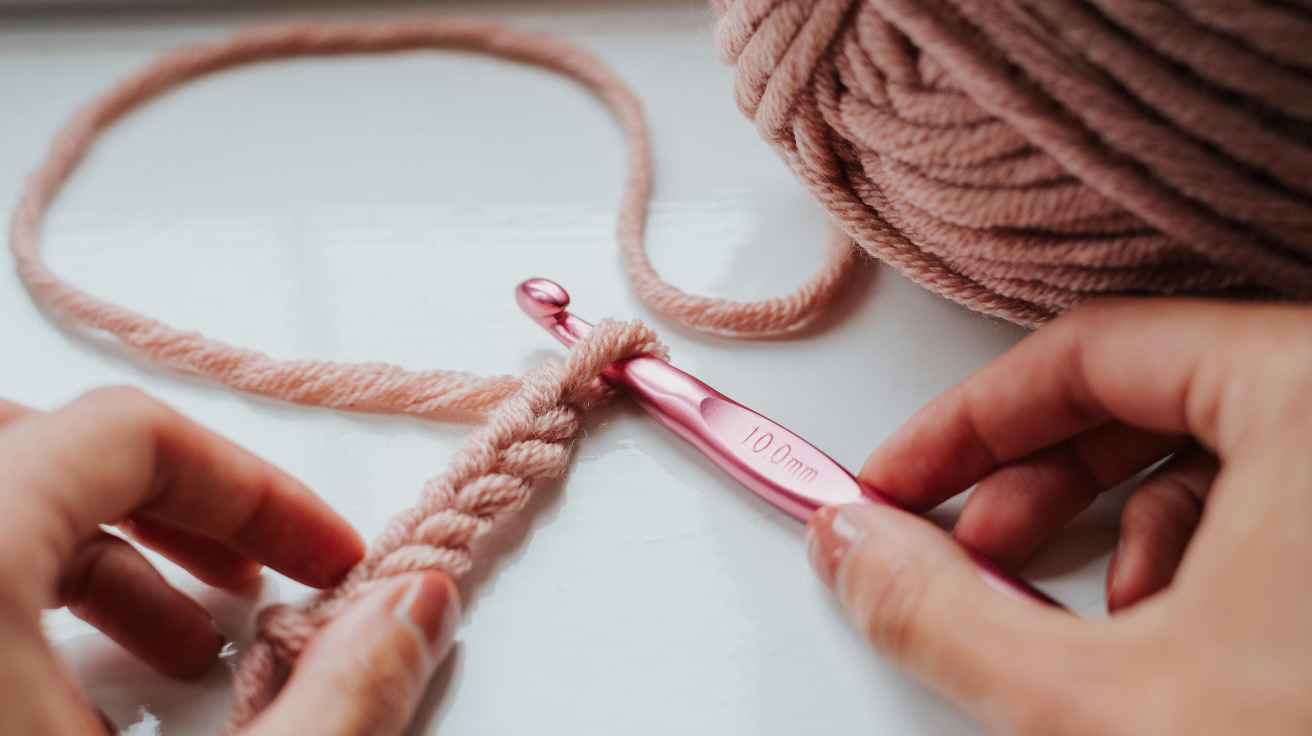
Start by making a slip knot and placing it on your crochet hook.
Next, make a foundation chain. For practice, chain about 12–15 stitches.
Try to keep your chains relaxed. Pulling them too tightly can make it difficult to insert your hook into the chain later.
Step 2: Yarn Over
Wrap the working yarn over the hook from back to front.
This is called a yarn over, often abbreviated as YO.
You should now have the yarn sitting over your hook before inserting it into the next stitch.
Step 3: Insert the Hook
Insert your hook into the appropriate chain stitch. For a basic practice row, you will usually work into the third chain from the hook. The loop currently on your hook does not count as a chain.
Step 4: Yarn Over and Pull Up a Loop
Yarn over again and pull the yarn through the chain.
You should now have three loops on your hook.
This is an important visual checkpoint. If you don’t have three loops, stop and check the previous step before continuing.
Step 5: Yarn Over Again
Wrap the yarn over your hook one more time. You are now ready for the final movement.
Step 6: Pull Through All Three Loops
Pull the yarn through all three loops on your hook at once.
That’s it—you’ve completed one half double crochet stitch.
The top of the stitch should look like a small “V.”
Quick HDC Formula
For an easy way to remember the movement:
Yarn over → insert hook → yarn over → pull up a loop → yarn over → pull through all 3 loops.
Repeat these steps across your row.
How to Start a New Half Double Crochet Row
Once you reach the end of a row, you’ll need to turn your work before starting the next row.
The turning chain can vary depending on the pattern and designer. A common approach for HDC is to chain 2 before beginning the next row.
Whether the turning chain counts as a stitch depends on the pattern instructions.
This is one reason it’s important to check the specific pattern you’re following rather than assuming every crochet pattern handles turning chains in exactly the same way.
Where Do You Insert the Hook for HDC?
For standard half double crochet worked in rows, you usually insert your hook under the top two loops of the stitch.
Those two loops create the small “V” you see along the top edge of your crochet fabric.
Working Through One Loop
Sometimes a pattern specifically asks you to work through the front loop only or back loop only.
Changing which loop you use changes the texture and appearance of your fabric.
For example:
- Both loops: Standard HDC fabric
- Front loop only: Creates a raised ridge
- Back loop only: Creates horizontal-looking ridges
Always follow the pattern instructions when a specific loop is mentioned.
Half Double Crochet vs. Single Crochet vs. Double Crochet
Understanding how HDC compares with other basic stitches makes it much easier to choose the right stitch for a project.
| Stitch | Relative Height | Main Technique | Fabric |
|---|---|---|---|
| Single crochet | Short | Pull through 2 loops | Dense |
| Half double crochet | Medium | Pull through 3 loops | Soft and moderately dense |
| Double crochet | Tall | Pull through 2 loops twice | More open |
Half double crochet is especially useful when you want your project to grow more quickly than it would with single crochet, without creating the openness that can come with taller stitches.
How to Keep Your HDC Edges Straight
One of the biggest frustrations for beginners is ending up with a triangle-shaped project instead of a rectangle.
The problem is usually stitch counting.
At the end of every row, count your stitches. If you started with 15 stitches, you should generally continue to have the same number of stitches in each row unless your pattern tells you to increase or decrease.
Count the First and Last Stitch Carefully
The first and last stitches can be easy to miss.
After turning your work, identify exactly where your first HDC should go. At the end of the row, look carefully for the final stitch before completing it.
A simple habit can make a big difference: count every row until your hands naturally recognize the stitch placement.
Common Half Double Crochet Mistakes
Even experienced crocheters occasionally make mistakes. Beginners commonly run into these problems.
Making the Foundation Chain Too Tight
A tight foundation chain makes it difficult to insert the hook.
Try loosening your grip or using a slightly larger hook for the foundation chain if your pattern allows it.
Skipping the First or Last Stitch
This causes your project to become narrower as you work.
Count your stitches regularly, especially during your first few rows.
Pulling the Yarn Too Tightly
Tight tension makes your stitches difficult to work into and can create stiff fabric.
Aim for an even, relaxed tension rather than trying to make every loop extremely tight.
Confusing HDC With Double Crochet
The biggest difference is what happens after you pull up the loop.
With HDC, you yarn over and pull through all three loops at once.
With double crochet, you work through the loops in separate stages.
How to Count Half Double Crochet Stitches
Counting HDC stitches becomes easier once you know what you’re looking for.
Look at the top edge of your row. Each stitch should have a visible V-shaped top.
Count each V from one side to the other.
Don’t count the turning chain unless the pattern specifically tells you that it counts as a stitch.
If you’re unsure, place a stitch marker in the first and last stitch of the row. This is particularly helpful when you’re learning.
How Tight Should Half Double Crochet Be?
There isn’t one perfect tension for every project.
Your tension should be consistent enough that your stitches have a similar size throughout the fabric.
If your HDC stitches are extremely tight, the fabric may become stiff. If they’re very loose, the fabric may have large gaps.
For a wearable item or a fitted project, making a gauge swatch is especially useful.
A Simple Gauge Tip
Make a small practice square using the yarn and hook you’ll use for your project. Measure it after completing several rows.
If your square is smaller than the pattern’s gauge, you may need a larger hook. If it is larger, you may need a smaller hook.
Always follow the specific pattern’s gauge instructions when available.
Half Double Crochet in the Round
Half double crochet isn’t limited to flat rows.
You can also use HDC when crocheting in the round for projects such as:
- Hats
- Bags
- Baskets
- Coasters
- Slouchy beanies
- Baby accessories
- Amigurumi-style shapes
When working in the round, pay close attention to increases and stitch counts. A small counting mistake can cause the project to curl, flare, or lose its intended shape.
Easy Projects Using Half Double Crochet
Once you’ve practiced the stitch, you don’t need to jump straight into a complicated pattern.
Start with a small project that lets you repeat the same movement.
Beginner HDC Dishcloth
A dishcloth is excellent practice because it is small and rectangular.
You can practice foundation chains, HDC rows, turning, counting, and finishing without committing to a large project.
Simple Scarf
A scarf gives you plenty of repetition. Once you establish your row, you can focus on keeping your tension consistent.
Crochet Headband
A headband is another quick project that can help you practice HDC while producing something useful.
Baby Blanket
After you’re comfortable with the stitch, HDC works well for simple blankets. Choose washable yarn and a color combination you enjoy.
A Beginner Practice Exercise
Here’s a useful technique that can help you learn faster.
Instead of immediately starting a large project, make a small HDC swatch.
Chain 15, work HDC across the row, turn, and repeat for about 10 rows. Then examine your fabric.
Look for three things:
- Are the stitches roughly the same size?
- Does each row contain the same number of stitches?
- Are the sides relatively straight?
If all three answers are yes, you’re already building the skills needed for larger HDC projects.
A Useful Trick: Learn the Stitch by Feel
Here’s a tip many beginner tutorials overlook: don’t rely only on looking at your stitches.
After you’ve made several rows, start paying attention to how the yarn feels as you make each movement.
The HDC rhythm becomes almost automatic:
yarn over, insert, pull up, yarn over, pull through three.
Once your hands learn that rhythm, you can crochet more comfortably without constantly stopping to check every movement.
Can Beginners Learn Half Double Crochet?
Yes. Half double crochet is considered one of the basic crochet stitches and is a practical stitch for beginners to learn after becoming comfortable with chain stitches.
The most important skills are understanding where to insert the hook, maintaining consistent tension, and recognizing the three loops before the final pull-through.
Don’t worry if your first few rows look uneven. Crochet tension usually improves with practice.
What Can You Make With Half Double Crochet?
HDC is a versatile stitch that can be used for both decorative and practical projects.
You can use it to make:
- Blankets
- Scarves
- Hats
- Cowls
- Bags
- Washcloths
- Dishcloths
- Baby blankets
- Headbands
- Pillow covers
- Sweaters
- Cardigans
Its medium height makes it particularly useful when you want a project to grow at a moderate pace while still keeping a relatively solid fabric.
FAQ
What is the easiest way to learn half double crochet?
The easiest method is to practice the stitch in a small swatch rather than starting with a large project. Learn the six basic movements separately, then repeat them until the sequence feels natural.
How many chains do I need to start HDC?
The number depends on your project. For practice, chain 12–15 stitches. For an actual project, follow the pattern’s foundation-chain instructions because the required number depends on the desired width and stitch pattern.
Does the chain 2 count as a half double crochet?
Not always. Some patterns count the turning chain as a stitch, while others do not. Always follow the pattern’s stated instructions for the turning chain.
Why does my half double crochet look like single crochet?
Your stitches may be tight, or you may be accidentally working a single crochet. Check that you yarn over before inserting your hook and that you finish the HDC by pulling through all three loops at once.
Is half double crochet faster than single crochet?
Generally, yes. HDC is taller than single crochet, so each completed row can add more height. Your actual crocheting speed will still depend on your yarn, hook, tension, and experience.
Conclusion
Learning a new crochet stitch doesn’t have to feel complicated. With this half double crochet tutorial, you now know the basic HDC sequence, where to insert your hook, how to count stitches, how to keep your edges straight, and how to avoid common beginner mistakes.
The best way to build confidence is to practice a small swatch before starting a larger project. Once the movement becomes familiar, try a simple dishcloth, scarf, headband, or blanket.
Grab your yarn and hook, make a foundation chain, and practice those six simple movements. Your first stitches may not be perfect—and that’s completely fine. Every row gives your hands a little more confidence.


One Comment